Basic chord theory and construction....page 4 of 4

  • Home
  • Online Guitar Tuition
  • Know your guitar - acoustic
  • Know your guitar - electric
  • Guitar Tuner
  • Basic chord theory and construction
  • Chord Formulas
  • Chord Windows
  • The first Time Ever I Saw Your Face
  • My Youtube
  • My Links
  • Sweet Child O Mine
  • Nothing Else Matters
  • Do You Hear What I Hear
  • Untitled-Feb 2014


As a final example, lets now assume you want to play an A seventh (A7) chord.

This is where some guitarists get confused especially with other band members who have no idea of music theory and just know a few chords as 7th chords. So lets get this part straight here.

There are basically 3 types of 7th chords which are all completely different. These chords are :

* Major 7th Chords     (written as maj 7)     (chord formula: 1 - 3 - 5 - 7)

* Minor 7th Chords     (written as m7)     (chord formula: 1 - b3 - 5 - b7)

* Dominant 7th Chords     (written as 7)    (chord formula: 1 - 3 - 5 - b7)


Most often the chord type referred to is the Dominant 7th chord. This is the bluesy sounding seventh chord often played. So if you are in a band and someone says play an A seventh, play the Dominant 7.....if they say "no thats wrong", then say, " well which did you mean, A major 7th, minor 7th or Dominant 7th?".

So the A dominant 7th chord has the formula  1  -  3  -  5  -  b7

Lets refer back to the A major diatonic scale again....
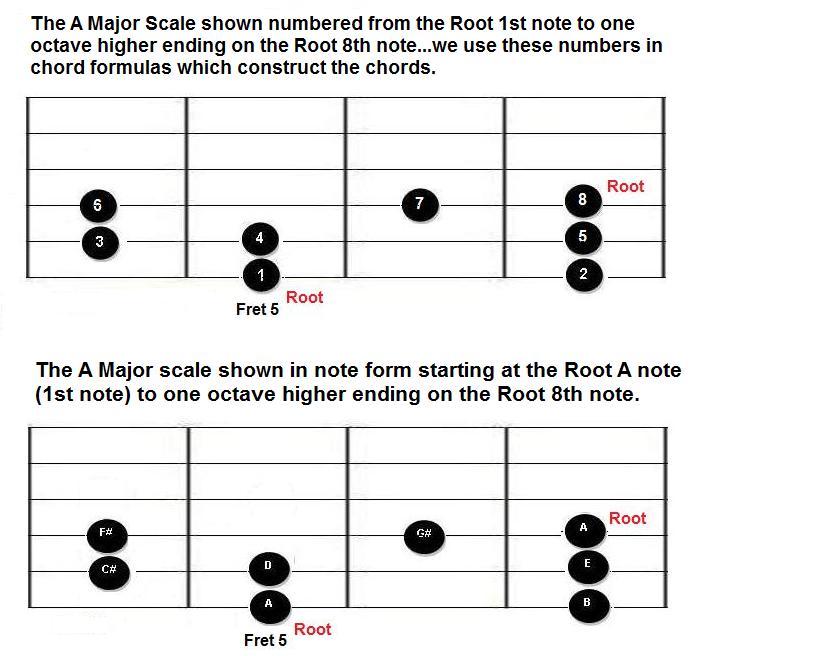

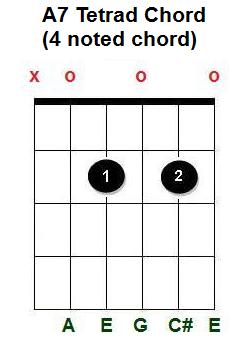
You will see from the formula the 1st (ROOT) note is A, the 3rd note is C#, the 5th note is E and the 7th note is a flattened G# which makes it a G. So we now take those notes    A - C# - E - G and construct them into the A7 chord as shown on the right. 

Click here to go to chord windows
Click here to return to previous page
Click here to return to Home Page

 
Make a Free Website with Yola.